
If you own an electric vehicle in Waltham Abbey, you might assume that your home EV charger is already giving you the fastest charging speed your property can support.
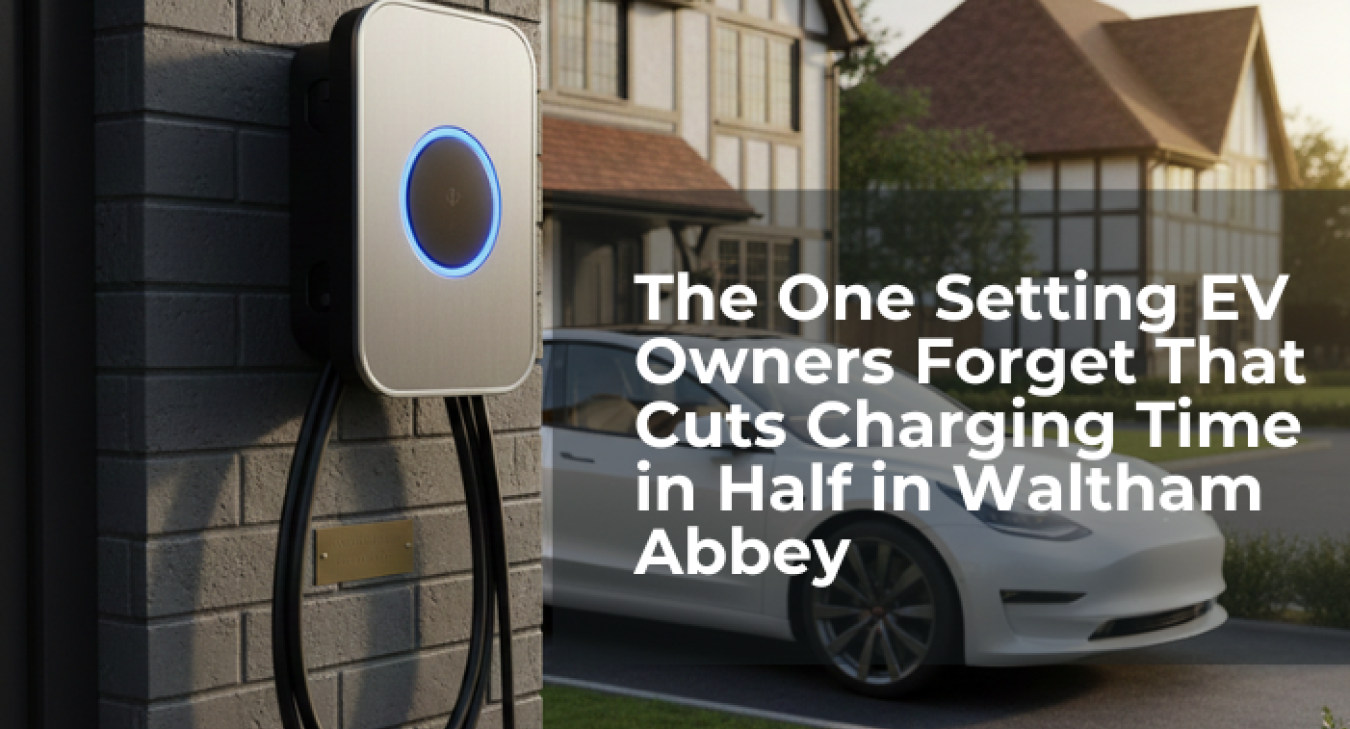
But for many EV drivers, that isn’t actually the case. One overlooked setting inside the charger or the vehicle can dramatically slow charging without you realising and simply adjusting it could cut your charging time in half.
Most homeowners think slow charging means the charger is faulty or their wiring can’t cope. But the truth is often far simpler: your EV charger, your car, or both may be set to a reduced charging rate without you knowing. It’s a hidden issue that our engineers see repeatedly during EV charger installations and callouts across Waltham Abbey.
In this blog, you’ll learn what this forgotten setting is, why it affects so many EV owners, how to check it, and how a qualified electrician can help you get the full performance from your charger.
Why Your EV Might Not Be Charging at Full Speed
Many modern electric vehicles and home chargers come with a “reduced current mode” or “limited charging mode”. This feature is useful in certain situations, such as when using a weak extension supply on holiday or when plugging into a low-capacity socket. But when enabled in a permanent home charging setup, it restricts the flow of power and turns a normally fast charge into a frustratingly slow one.
Despite this setting being designed for safety, it often becomes activated accidentally or left on from a previous use. Because nothing on the charger indicates that this mode is active, homeowners assume the charger itself is slow or faulty. This leads to wasted time, energy, and in many cases, unnecessary replacement advice.
In Waltham Abbey, older properties with lower-rated circuits are especially prone to this issue, as chargers automatically limit power if they sense instability. Once the circuit is upgraded or stabilised by a professional, the charging rate can typically be restored but only if this hidden limiter is turned off.
How Much Difference Can This One Setting Make
More than most EV drivers realise.
A typical 7kW home EV charger in Waltham Abbey should be able to add around 25–30 miles of range per hour. But with reduced charging mode active, many chargers drop to as low as 3kW or even 2kW. That means:
- A full charge that should take 6 hours can suddenly take 12.
- Topping up overnight becomes impossible because the battery never reaches the expected level.
- Smart overnight schedules don’t work because the reduced rate runs out of time.
- Homeowners think their charger is faulty when it’s actually working correctly but restricted.
In simple terms, this hidden setting can cut your charging speed in half, or worse.
Why This Problem Is So Common in Waltham Abbey
Because the electrical infrastructure in Waltham Abbey includes a mix of new builds, older terraced homes, and extensions added over several decades, many properties have a patchwork of circuit capacities. As a result:
- Chargers automatically reduce current if they detect minor fluctuations.
- Properties with extensions or loft conversions may have circuits that were never intended for EV use.
- DIY electrical work in older homes can confuse the charger’s internal monitoring.
- Some smart chargers switch to reduced mode after a power cut or router reboot.
Homeowners rarely realise this because their EV still charges, just slowly. And unless an electrician checks the charger settings, the issue goes unnoticed.
How to Check Whether Your Charger Is Being Limited
There are three places where the reduced current setting can be hiding:
Inside the EV charger app:
Most smart chargers allow you to manually adjust the amperage. If it is set below 32A, your charging speed will be reduced.
Inside your car’s charging settings:
Many EVs allow the driver to limit the charging current. Owners often activate it while visiting a friend or using a low-power socket and forget to switch it back.
Inside the charger’s internal configuration:
After a brownout, power cut or electrical disturbance, some chargers revert to a safe reduced mode automatically.
If you’re unsure where the limitation is coming from, an electrician can run diagnostics and confirm the full charging capability of your property.
Why Professional Testing Matters
A qualified EV electrician in Waltham Abbey can check:
- Whether your EV charger is correctly configured
- Whether your consumer unit supports full-speed charging
- Whether load-balancing or surge-protection settings are limiting power
- Whether your home wiring needs upgrading for stable 7kW charging
- Whether your charger is responding to an actual safety issue rather than a false detection
Without proper testing, you might switch the limiter off when the charger is restricting itself for a genuine safety reason. That’s why an electrical inspection is so important.
When to Call an Electrician
If your EV charger in Waltham Abbey feels slower than expected, or if your charging times have suddenly changed without explanation, it’s time to get the system checked properly. The solution is often quick, affordable, and far simpler than homeowners expect.
- You don’t need a new charger.
- You don’t need a new vehicle.
- You don’t even need major electrical work most of the time.
- You just need a correct diagnosis and the right setting applied.
Book a Charging Speed Check in Waltham Abbey
If you want to make sure your EV charger is running at full speed and safely configured, our qualified electricians can help. We carry out complete EV charger testing, diagnostics, and system optimisation across Waltham Abbey.
📞 Call JJB Electrical on 01992 276087 for professional EV charger support in Waltham Abbey.